Via delle Abbazie
Italy's great gravel route: a secular pilgrimage from the Alps to Montecassino
The Project
Via delle Abbazie is a modern, secular pilgrimage by bike: Italy's great gravel route, from the Alps to Montecassino Abbey. Like the Camino de Santiago, it is open to everyone, believers and non-believers alike: you don't need faith, you need curiosity. It's not a race, not a vacation. It's a slow journey through landscapes, silence, and places where time moves at a different pace.
Twenty-nine abbeys, monasteries, and hermitages mark the path: stops of meaning, not of doctrine. The rest — the white roads, the Apennine passes, the cycle paths along rivers — is ridden on gravel and lends itself to fully self-supported bikepacking. Official opening in 2027.
The Three Routes
Three cycle routes traverse Italy from north to south. The Levante route starts from Novacella (Alpine Way), with the Adriatic variant (Adriatic Entry) from Rosazzo rejoining at Praglia. All converge toward Montecassino Abbey.
Ponente Route
19 stages · ~1,260 km · ~10,680 m elevation
From Piedmont through Liguria and Tuscany to Montecassino. The Tyrrhenian side, among wine hills, jagged coast, and Casentino forests.
Centro Route
16 stages · ~822 km · ~7,710 m elevation
From Milan or Brescia (Brescia Variant) through the Emilian Apennines, Casentino Forests, and Umbria to Montecassino.
Levante Route
20 stages · ~1,135 km · ~7,330 m elevation
From Trentino (Alpine Way) or Friuli (Adriatic Way) through Veneto, the Adriatic coast, and Marche to Montecassino.
An idea born in the Atacama Desert.
The Three Routes
Explore the details of each route
Direttrice Ponente
19 stages · ~1,260 km
From Piedmont (or from Turin with the Turin Variant) through Liguria and Tuscany to Montecassino.
Direttrice Centro
16 stages · ~822 km
From Milan or Brescia (Brescia Variant) through the Apennines and Umbria to Montecassino.
Direttrice Levante
20 stages · ~1,135 km
From Trentino (Alpine Way) or Friuli (Adriatic Way) through Veneto, the Adriatic coast, and the Marche to Montecassino.
The 29 Abbeys
Monasteries, hermitages, and basilicas along the three routes. Not just stops: the places where the journey finds its meaning.
The abbeys give the route, the way. Not the destination. Becoming a pilgrim again means rediscovering the same spirit of travel and discovery, of letting go, of the unexpected and the new. Because the journey is not arriving. It is seeking.
Where possible, stop, visit, have your credential stamped. Many abbeys offer guesthouses for pilgrims.
Abbazia di Montecassino
Founded in 529 AD by Saint Benedict of Norcia. The cradle of Western monasticism and the final destination of all routes of Via delle Abbazie. Destroyed and rebuilt four times in history, it is the symbol of human spirit's tenacity.
All routes converge here.
Ponente Route
From Piedmont through Liguria and Tuscany to Montecassino
 Photo: Elio Pallard · CC BY-SA 4.0
 Photo: Fabrizio Lunardi · CC0
The Stages
Centro Route
From Milan (or Brescia, with the Brescia Variant) through the Emilian Apennines and Umbria to Montecassino
 Photo: Oldangia · CC0
 Photo: Chris Light · CC BY-SA 4.0
The Stages
Levante Route
From Trentino (Alpine Way) or Friuli (Adriatic Way) through the Adriatic coast and Marche to Montecassino
 Photo: CristianNX · CC BY-SA 3.0
 Photo: Peter Forster · CC BY-SA 2.0
The Stages
Interactive Map
Plan Your Journey
Everything you need to know before setting off
Which Route to Choose
Ponente
19 stages · ~1,260 km · ~16 days
Challenging
Much gravel, significant climbs. For trained cyclists. Extraordinary Tuscan and Apennine landscapes.
Centro
16 stages · ~822 km · ~13 days
Moderate-Challenging
The shortest. Apennines and Umbria. Good mix of challenge and accessibility.
Levante
20 stages · ~1,135 km · ~15 days
Moderate
Two starting points from major lakes/rivers of the North-East (Trentino and Friuli). Easy cycling in the North, challenging climbs in Marche and Abruzzo. They converge toward Montecassino.
Practical Information
When to Depart
The best time is from April to June and from September to October. Summer can be very hot in central-southern Italy, especially in Ciociaria and Abruzzo. Autumn brings extraordinary colors to the Casentino Forests and Umbria.
What Bicycle to Use
We recommend a gravel bike or a touring bike with tires at least 40 mm wide, ideally 45. Many sections are on gravel or white roads. The Levante route and its Adriatic variant have more asphalt and cycle paths, suitable also for classic cycle touring bikes or e-bikes.
Where to Sleep
Many abbeys offer guesthouses for pilgrims — it's the most authentic experience of the Way. Alternatively: farm stays, B&Bs, hostels. On stages without an abbey, intermediate towns always have accommodation options.
Estimated Budget
Monastery guesthouses: free offering or 20-40€/night with dinner. B&Bs and farm stays: 50-80€/night. Budget approximately 30-50€/day for meals and small expenses. Total for Centro (~13 days): approximately 700-1,100€.
Bike + Train
All routes touch or pass near major train stations. The Levante departs from the Adige cycle path (train to Bressanone). The Adriatic variant of the Levante from the Alpe-Adria cycle route (train to Udine). You can break the journey and resume from an intermediate station.
Physical Level Required
It's not a race. Stages vary from 22 to 95 km with elevation gains from 20m to 1,200m. For Ponente and the Apennine stages you need good fitness. The first stages of the Levante and its Adriatic variant are flat and suitable for everyone.
What to Bring
Essential items for a multi-day bicycle pilgrimage: layered technical clothing, compact waterproof jacket, repair kit (tube, pump, multi-tool), lights, lock, water bottle of at least 1L. For guesthouses: sleeping sheet sack or lightweight sleeping bag. The credential printed, to be stamped at each abbey. A cycle computer or smartphone with the GPX tracks loaded.
Bikepacking and Self-Sufficiency
The Way lends itself to full bikepacking: tent or bivy, complete self-sufficiency, no bookings. Every route can be ridden sleeping outdoors, from one abbey to the next. The first 46 overnight spots are already mapped: you'll find them on the elevation profiles and maps of each route. For your setup we recommend bikepacking bags (saddle, frame, handlebar): on gravel sections and white roads, heavy panniers hurt handling and rhythm. Travel light: it's the oldest form of pilgrimage.
Download GPX
Download GPS tracks for each route and use them with your device
Ponente
19 stages · ~1,260 km
Centro
16 stages · ~822 km
Levante
20 stages · ~1,135 km
Pilgrim Credential
Your travel document along Via delle Abbazie. Print it, carry it with you, and have it stamped at each abbey you visit.
Bicycle Pilgrim Credential
Via delle Abbazie · From the Alps to Montecassino
Bicycle pilgrimage through 29 Italian abbeys
Pilgrimage Stamps
Have each abbey you visit along the way stamp your credential
Abbazia di Montecassino
Final destination · Cradle of Western monasticism
Certificato di completamento
The Project
Via delle Abbazie is born from the idea of connecting Italy's great monasteries in a single cycle tourism route. Not a race, not an athletic challenge: a secular pilgrimage that traverses Italy along its cultural and spiritual ridges.
Three routes — Ponente, Centro, and Levante, with the Adriatic variant (Adriatic Entry) rejoining at Praglia — converge toward Montecassino Abbey, the cradle of Western monasticism founded by Saint Benedict in 529 AD.
The project follows where possible the major Italian cycle routes: the Adige Cycle Path, the Valsugana, the Alpe-Adria Cycle Route, the Po Cycle Route, the Sun Cycle Route. Where cycle paths don't exist, the route crosses secondary roads and historic trails.
2026 is the year of development. We are mapping the routes, contacting abbeys and building the hospitality network for cyclist-pilgrims. Every stage is being verified on the ground.
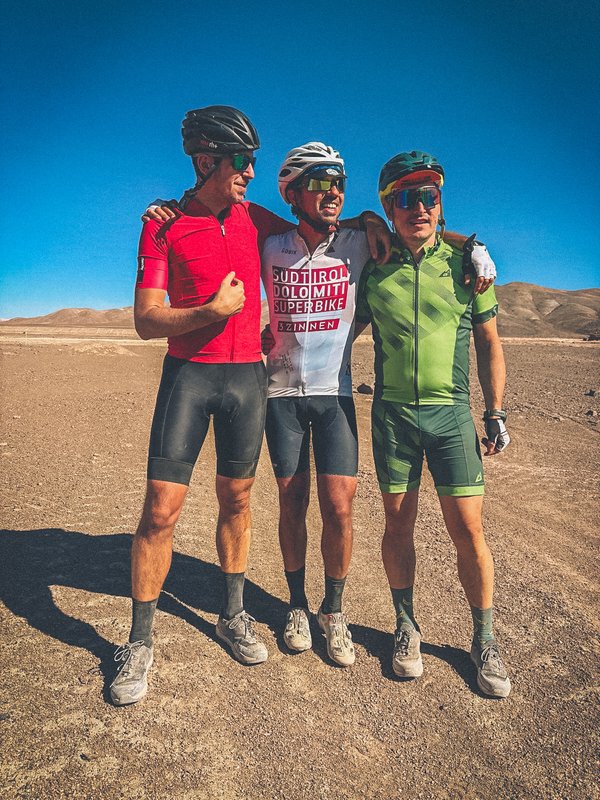
Andrea Bariselli · Claudio Sabatti · Andrea Razio
Beyond Italy
A European network of bicycle pilgrimages
Via delle Abbazie doesn't end at Montecassino. It's the beginning of a larger conversation with Europe's great monastic traditions. Sacred mountains, island-abbeys, monasteries suspended in the sky: a network of secular bicycle pilgrimages connecting the spiritual ridges of the continent. Places of silence and beauty, not of doctrine: open to anyone who seeks them.
Canterbury
England
The cathedral where Thomas Becket was assassinated. Natural connection heading up the Via Francigena from Rome, passing through Siena, Lucca, the Great Saint Bernard Pass to Canterbury.
~2,800 km | Bicycle Via Francigena
Santiago de Compostela
Spain
From the Camino to Finisterre, "the end of the world". From Ponente through the Côte d'Azur and Catalonia, or along the Aragonese Way.
~2,400 km | Camino de Santiago
Mont Saint-Michel
France
The island-abbey in the heart of Normandy. Connection through Provence and the Loire Valley, one of the most iconic places of European monasticism.
~2,100 km | Via della Provenza
Monasteri di Meteora
Greece
The monasteries suspended on the cliffs of Thessaly. Eastern extension from the Adriatic variant of the Levante through Slovenia, Croatia and the Balkans.
~2,500 km | Balkan Way
Clonmacnoise
Ireland
The Celtic monastic tradition that "saved civilization". An Atlantic extension for the more adventurous, toward the roots of European monasticism.
~2,900 km | Atlantic Way
Montserrat
Catalonia
The abbey in the mountain, sacred in Benedictine monasticism. Connection from Ponente through Provence toward Catalonia.
~1,800 km | Provençal Way
Via delle Abbazie doesn't end at Montecassino.
It ends where your curiosity ends.
Join the Project
Four ways to participate in Via delle Abbazie
For Bicycle Pilgrims
Download the GPX files, read pilgrim journals, subscribe to the newsletter for updates on abbeys and routes.
For Abbeys
If you represent an abbey that wants to join the Via delle Abbazie network, contact us to discuss hospitality, credential stamps, and initiatives.
Contact UsFor Guides & Escorts
Know a section of Via delle Abbazie well? Become a local guide, accompany pilgrims, share your experience.
Propose CollaborationFor Institutions & Organizations
Want to support the project with signage, cycle infrastructure, or partnerships? We're open to public-private collaborations to improve the routes.
Institutional Proposal